Full-stack product engineering
Relay
A project-operations workspace built for an electrical-engineering company, carrying schedules, tasks, responsibilities, and reporting between teams.
Case navigation
Jump toShowcase
Product view / 01
Dashboard
Dashboard overview with project status, ownership, and progress signals. Public demo with synthetic, browser-local records.
Open full image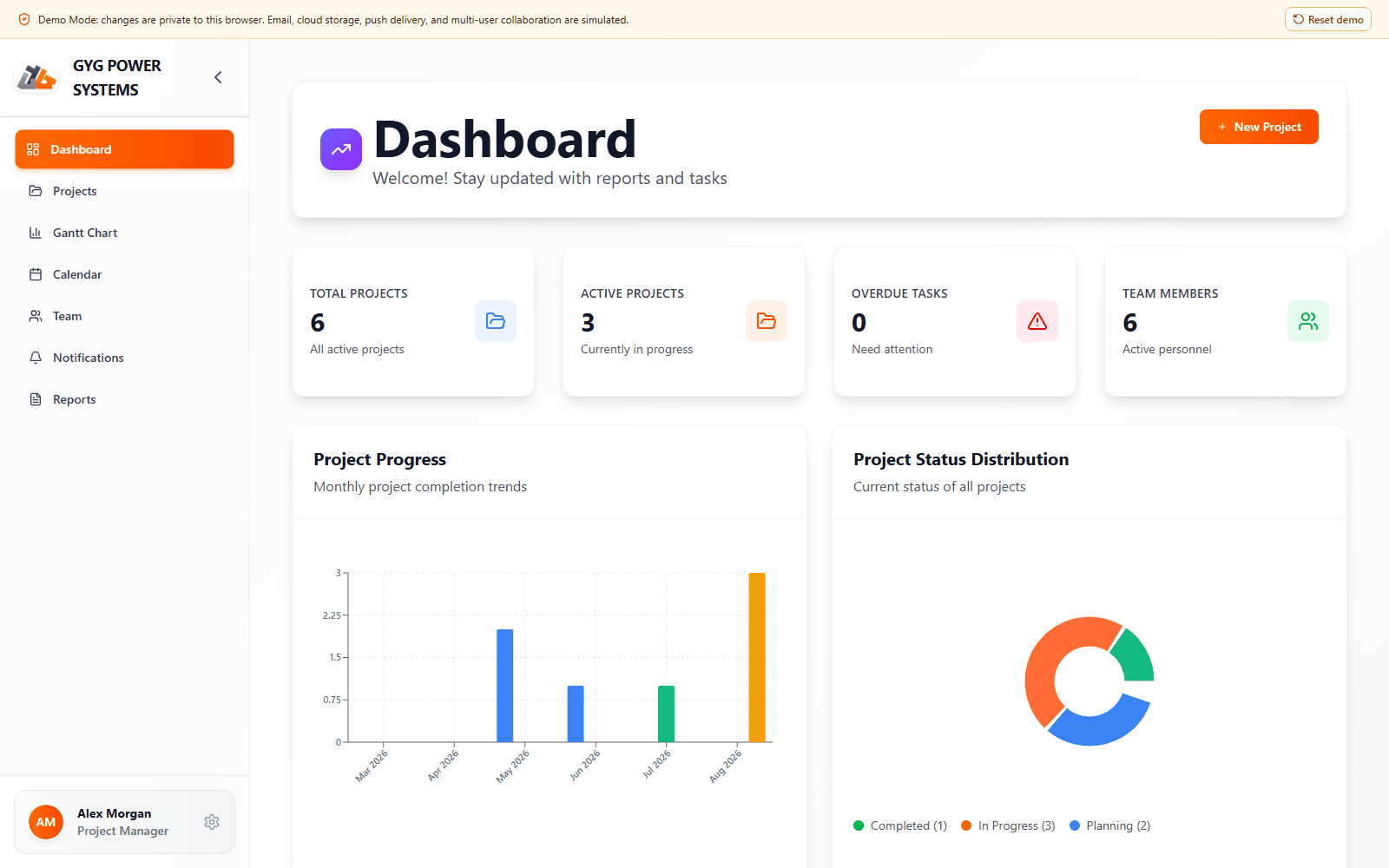
Dashboard, feature 01 / 06
02 / Challenge
Project information loses value when the workflow around it is fragmented.
Planning, scheduling, progress updates, and reports are closely related, but they are often handled as separate documents. That makes ownership harder to see and turns routine coordination into manual reconciliation.
Relay's name reflects that role: like an electrical relay passing a signal onward, the workspace carries tasks, milestones, and reporting context between teams.
The interface therefore had to expose project context, responsibility, and next actions without turning every screen into a dense administrative dashboard.
- Keep role-dependent actions and ownership understandable.
- Keep schedules, project records, and reports consistent.
- Support detailed operational work without losing scanability.
03 / Approach
Typed product states connected information to the actions people needed to take.
The Next.js and React interface models projects, schedules, reporting actions, and role-aware states explicitly. TypeScript keeps those contracts visible across views, while hosted services support persistence and product integrations.
- Organized navigation around user jobs rather than implementation modules.
- Used shared typed models so status and schedule data retain the same meaning across views.
- Designed responsive behavior as part of each workflow instead of treating it as a final visual pass.
04 / Result
The result is a working product demo—and a clearer approach to operational software.
The public demo makes the core project, timeline, document, and reporting workflows available for direct inspection. It demonstrates the product as a connected system without relying on unsupported productivity metrics.
Building Relay made the cost of ambiguous state visible: a polished screen is not enough when people cannot tell who owns the next action or how one update affects the wider project.
What I would improve next
- Formalize the domain and access models earlier, alongside each workflow.
- Add structured usability and performance validation before publishing numerical outcome claims.